
Resources > Dynamics 365 vs Salesforce: A Guide for 2026
AI Chat Platforms Are Becoming Ad Channels for Businesses
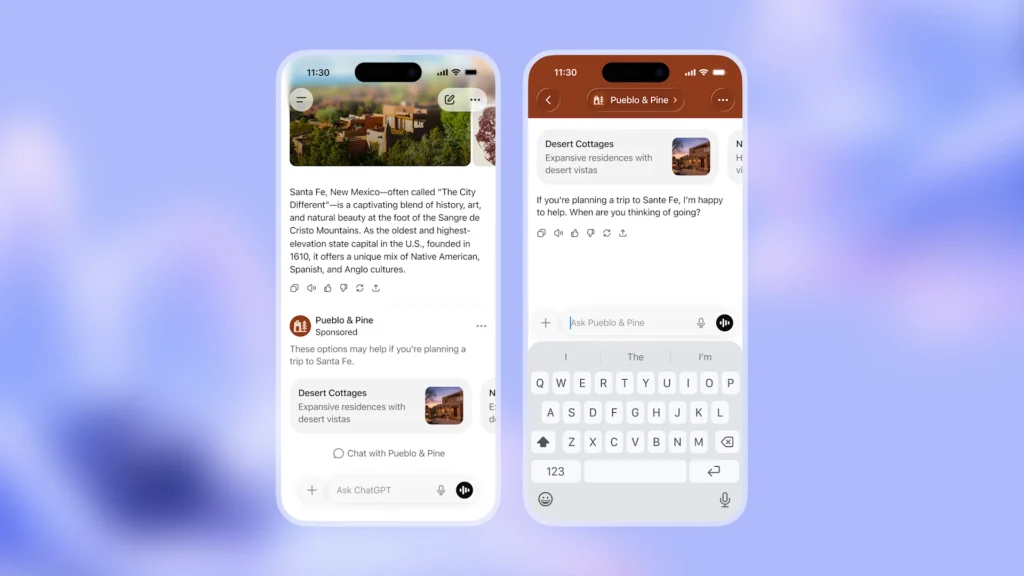
ChatGPT Chatbot Mobile Screens with Sponsored Ads
Key Takeaways
- Over 2,000 brands now run ads on ChatGPT, with availability expanding to the UK, Japan, and South Korea.
- Google is building four new ad formats into AI Mode. Conversational Discovery ads, Highlighted Answers, AI-powered Shopping ads, and Business Agent for Leads.
- Ad creative is now generated per query. Instead of a static headline, Gemini assembles the ad copy in real time based on exactly what a user asked.
- Google’s Ads Terms of Service changed on July 1. AI can now build campaigns, but advertisers still bear full responsibility.
- Early performance signals look strong. Criteo reports ChatGPT-referred conversion rates nearing double other channels, alongside falling CPMs.
AI Chat is Now Displaying Ads
Artificial intelligence is moving from a tool that helps run ads to a surface where ads themselves appear. OpenAI has scaled its ChatGPT advertising pilot to more than 2,000 brands across seven countries. Google has introduced four new Gemini-powered ad formats built specifically for its AI Mode search experience. And Google has quietly rewritten its Ads Terms of Service to formalize how much of the ad creation process AI can now handle on an advertiser’s behalf.
Together, these changes mark the point where conversational AI stops being just a research and content tool for marketers and starts being both a paid media channel and a source of new accountability questions. This piece breaks down what changed, what the early data shows, and what marketing teams should do about it.
Why This Matters Right Now
For most of this year, “AI and advertising” has mostly meant AI-assisted campaign management: automated bidding, generated headlines, smarter audience targeting. That’s changing. As of July 2026, AI systems are becoming advertising surfaces in their own right, places where the ad and the answer are the same object. ChatGPT now carries paid placements at meaningful scale, and Google is testing several formats that embed sponsored content directly inside AI Mode’s conversational responses.
This shift matters for marketers on two levels. First, it opens a genuinely new channel with different economics, different creative requirements, and early-mover conversion data worth paying attention to. Second, it changes who is accountable when an AI system writes or selects the ad copy that reaches a customer. At least on Google’s platform, the answer is unambiguous: the advertiser is.
ChatGPT Ads Move From Pilot to Real Channel
OpenAI’s advertising pilot began quietly in March 2026, when Criteo announced it had become the first ad-tech partner integrated into ChatGPT’s Free and Go tiers in the United States, connecting roughly 17,000 advertisers to the platform. Early data behind that launch showed traffic referred from ChatGPT converting at meaningfully higher rates than other referral channels, a signal that this audience was arriving with unusually high purchase intent.
The pace of expansion since then has been fast. Within six weeks, the pilot had reportedly crossed $100 million in annualized revenue, prompting OpenAI to expand into Canada, Australia, and New Zealand and to bring on a global head of advertising solutions. By May, Criteo reported more than 1,000 brands running live campaigns, alongside a self-serve Ads Manager opening to all U.S. businesses and the introduction of cost-per-click bidding alongside the existing CPM model. Reported CPMs fell over the same period, from roughly $60 at launch down toward the $25–$35 range as inventory and competition grew.
By late June, the numbers had roughly doubled again: Criteo disclosed that more than 2,000 brands were now advertising on ChatGPT, with the pilot expanding into the UK, Japan, and South Korea, its first non-English-speaking markets. That expansion is a meaningful test of whether conversational ad formats translate across different regulatory environments and consumer behaviors, not just different languages.
For marketers, the practical upshot is that ChatGPT advertising has moved past the “interesting experiment” phase. It has a self-serve interface, competitive CPMs, published performance benchmarks, and a widening set of available markets. Teams that haven’t yet evaluated it as a channel are increasingly the exception rather than the norm.
Google Wires Paid Placements Into AI Mode
Google made its own move at Google Marketing Live in May 2026, introducing four Gemini-powered ad formats designed specifically for AI-driven search:
- Conversational Discovery
Ads generate creative on the fly in response to the specific way a person phrases a question, rather than matching a static ad to a keyword. - Highlighted Answers
insert sponsored results into AI Mode’s list-style recommendation responses, for instance when someone asks for the best language-learning apps for an upcoming trip. - AI-powered Shopping
Ads use Gemini to match products to a shopper’s specific query and generate a custom explanation of why a given product fits their stated needs, rather than showing a generic price-and-image listing. - Business Agent for Leads
Replaces the static contact form at the end of a lead-gen ad with a Gemini-powered chat agent trained on the advertiser’s own site, letting a prospective customer ask questions and get a pre-filled lead form.
All of these formats carry a “Sponsored” label, and Google pairs the ad creative with what it calls an independent AI-written explainer: a separate, Gemini-generated note evaluating the product or service alongside the advertiser’s own messaging, intended to add a layer of transparency.
Conversational Discovery ads and Highlighted Answers are currently in testing in the U.S. on both mobile and desktop. Business Agent for Leads is in open beta for U.S. advertisers, and AI-powered Shopping ads are expected to roll out more broadly later this year. None of the four is fully, publicly live yet, but all four are the clearest signal so far of where Google intends AI Mode advertising to go.
Google’s New Terms of Service States Liability Unchanged
Alongside these new formats, Google made a quieter change: a rewrite of its Google Ads Terms of Service, effective July 1, 2026, applied automatically to every account with no login prompt or acceptance step required.
The prior terms, largely unchanged since 2018, described features like automatically created assets, Final URL Expansion, and Performance Max as optional tools an advertiser could choose to enable.
The new terms drop that framing. They explicitly authorize Google to use automated systems to format, select, or generate targets, ads, and destinations on an advertiser’s behalf as a default part of how the account operates, not an opt-in program feature. The terms also clarify that information and URLs entered into conversational tools like Ads Advisor can be used across other Google Ads features to improve performance.
What the new terms do not do is shift responsibility for the output. Google’s language is explicit that advertisers retain the ongoing obligation to review, approve, or remove any campaign or ad asset that automation generates. If an automatically created headline references wrong information, that is the advertiser’s policy violation and potential legal exposure, regardless of the fact that a model produced it.
Advertisers can limit some of this exposure at the campaign level. Features like Final URL Expansion and Automatically Created Assets can be turned off within Performance Max and similar campaign types, but the underlying contractual authorization applies to the account as a whole and cannot be opted out of entirely.
What This Means for Marketing Teams
Put together, these two developments point to the same practical conclusion from different directions. On the demand side, AI chat interfaces are becoming real advertising inventory with real budgets attached. On the supply side, the platforms running that inventory are formalizing a model where AI generates more of the creative and targeting decisions, while accountability for that output stays entirely with the advertiser.
Recommended steps to take:
- Treat AI chat placements as a channel to test.
With ChatGPT ads now running and falling CPMs, the cost of testing is lower than it was even a few months ago. - Rebuild creative workflows around per-query generation.
Conversational Discovery ads and similar formats reward strong structured product data, varied creative assets, and landing page quality over a single polished static ad, since the model assembles the message dynamically. - Put a human review step in front of everything
Given that Google’s updated terms confirm liability sits with the advertiser regardless of who or what generated the asset, this is no longer optional housekeeping. - Loop legal and compliance in
Particularly for regulated categories, since an AI-generated claim that violates policy or misstates a fact is treated as the advertiser’s error. - Brief clients and stakeholders on this liability shift directly
Agencies in particular should make sure account owners understand that automation efficiency comes with an unchanged, and in some ways clarified, review burden.
AI systems are no longer just tools that help marketers build ads faster. They’re becoming places where ads themselves live, and systems that write ad copy with less human involvement at each step. Both shifts are moving quickly: ChatGPT’s advertiser base has roughly doubled twice in a few months, and Google’s four new AI Mode formats are already in testing or open beta. The upside for marketers is real: higher-intent traffic, more relevant creative, and new discovery surfaces. The obligation that comes with it is just as real. Someone on the team still has to know what the AI actually said on the brand’s behalf, and platforms have now made clear in writing that this responsibility isn’t going anywhere.